

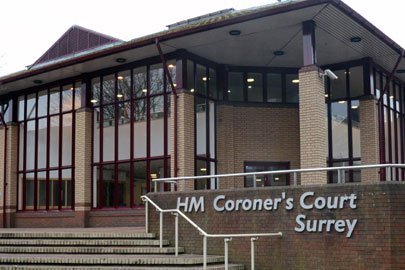

H.M. Coroner For Surrey

You are here

Skip to navigation

Coroner of The Queen's Household

H.M.Coroner for Surrey


For currrent information please follow the link

Inquest into the deaths of

Diana, Princess of Wales and Dodi Al Fayed


Tuesday, 6 January 2004

Openings of the Inquests
into the deaths
of

Diana, Princess of Wales
Queen Elizabeth II Conference Centre, London

and of  

Dodi Al Fayed
Wray Park, Reigate, Surrey

Coroners' Officers in attendance

At the Opening of the Inquest into the death of Diana, Princess of Wale,s Queen Elizabeth II Conference Centre, London

Mrs Camille JULIFF
One of the Officers of The Coroner of The Queen's Household

At the Opening of the Inquest into the death of Dodi Al Fayed, Wray Park, Reigate, Surrey

Mr Keith BROWN
One of the Officers of H.M Coroner for Surrey

Personal Details of the Deceased Persons

The personal details, as presently recorded, are as below.

Diana, Princess of Wales

Full Name:                 Diana Frances MOUNTBATTEN-WINDSOR
Date of Birth:                   1 July 1961
Place of Birth:                   Sandringham, Norfolk
Surname at Birth:           Spencer
Date of Death:                 31 August, 1997

Place of Death:                 Paris, France

Residence:                Kensington Palace, London, W.8

Dodi Al Fayed

Full Name:                 Emad El-Din Mohamed Abdel Moneim FAYED

Date of Birth:                   15 April 1955

Place of Birth:                   Egypt

Date of Death:                 31 August, 1997

Place of Death:                 Paris, France

Residence:                60, Park Lane, London W.1

Occupation:                Company Director


Coroners' Statement

1.  Introduction - Shortly after midnight, on Sunday, 31 August 1997 in central Paris, there was a car crash, and the two rear seat passengers, together with their driver, received injuries that resulted in their deaths.   The passengers' bodies were individually brought back to England later that day.  

2.  To-day, the inquests to establish the facts of those deaths are being opened. In this statement I explain what an inquest is, the law and practice relating to inquests, why it has taken so long to open these cases and why I am opening them today. I will also identify some of the issues to be addressed in due course and describe how I plan to proceed. I will not today cover matters of specific evidence. This is not intended to be a complete and exhaustive statement covering every aspect of the law.

3.  What is an Inquest - The purpose of an inquest is limited.   It is to find answers to four important but limited questions. It is carried out by a coroner who is an independent judicial officer established by act of Parliament1 His responsibility is centred on the body of the deceased person. His authority arises from the physical presence of that body in his district2 even if it is subsequently removed from it and his focus thereafter is, initially at least, also on the body and the medical cause of death. The inquest thereafter is gradually widened into what events or disease processes gave rise to that medical cause of death.   The coroner works outward from the body of the deceased person as the central or starting point.

4.  The inquest that the coroner undertakes receives or hears evidence relating to the body of the deceased person. It relies upon witnesses giving evidence, either sworn evidence, which can be tested and challenged, or documentary evidence. It is a long-established, tried and tested process for investigating the factual circumstances of a death and is fundamentally different in nature and scope to the well-understood adversarial system which we see applied in our criminal and civil courts.  

5. In an inquest there is no prosecution and no defence, but rather a single search for the truth.   Unlike other English Courts, the inquest does not depend upon a particular proposition or claim being made or argued for, and then challenged. Instead, at an inquest the evidence is considered and then from that evidence a proven chain of causation is drawn ending with the demonstrable medical cause of death.

6.  An inquest is not a public inquiry which works to terms of reference drafted to address the specific circumstances under consideration. Nor is it a rubber-stamping exercise. Its single-minded aim is to find the answers to the questions - who the deceased person was, and how, when and where the cause of death arose.   The conclusion or verdict at an inquest has to be based upon the evidence as proved, not on speculation.3   Expressions of opinion on any other matter - for example, on who might be to blame - are not allowed4 although actions, based on the evidence thrown up by the inquest, may sometimes be taken in the criminal or civil courts where matters of liability can be addressed.  

7.  When answering the question " how ... the cause of death arose ", we are told by Sir Thomas Bingham, Master of the Rolls, sitting in the Court of Appeal in 19945, that "'how' is to be understood as meaning 'by what means'. It is noteworthy that the task is not to ascertain how the deceased died, which might raise general and far-reaching issues, but 'how .... the deceased came by his death', a more limited question directed to the means by which the deceased came by his death ".

8.  About 20 years ago, Lord Lane described the coroner's inquest in these terms6 - " A coroner's task ... is a formidable one, and no one would dispute that; that is quite apart from the difficulties which inevitably arise when feelings are running high and the spectators are emotionally involved and vocal.   Once again it should not be forgotten that an inquest is a fact-finding investigation and not a method of apportioning guilt.   The procedure and rules of evidence which are suitable for one are unsuitable for the other.   In an inquest it should never be forgotten that there are no parties, there is no indictment, there is no prosecution, there is no defence, there is no trial, simply an attempt to establish facts.   It is an inquisitorial process, a process of investigation, quite unlike a trial where the prosecutor accuses and the accused defends, the judge holding the balance or the ring, whichever metaphor one chooses to use. "

9.  Deaths Abroad - The law is clear; when a death occurs outside England and Wales, a coroner will become involved if the body is brought into his district and he " .. has reason to suspect that the deceased has died a violent or unnatural death, [or] has died a sudden death of which the cause is unknown "7

10.  The Home Office, in 19838, advised coroners that, in cases where a body was repatriated, responsibility should be assumed by the coroner for the district where the body would ultimately be buried or cremated. I will deal with this in more detail in a moment 9.

11.  The inquest process makes no distinction between cases where the death occurs in England or Wales and when it occurs abroad, even though there may well be practical difficulties in obtaining the evidence from witnesses if they are abroad. Inevitably, the coroner has to rely to a large extent on any investigation carried out by the foreign police or judicial process, supplemented by any evidence obtainable from witnesses who may be available in England and Wales. This all takes time and even in simple cases, the delay can be expected to be years rather than months.

12.  Opening Inquests - It is unusual for an inquest not to be opened (even if then immediately adjourned) soon after the death and if the body is to be cremated, this is essential. In each of these two cases, a burial order was issued immediately after the post-mortem medical examination was made on 31 August 199710.

13.  The time has now come for me to open these inquests.   I do so in the knowledge -

a.  that I believe that the French proceedings are coming to an end;

b.  that it will give authority to those making or furthering inquiries on my behalf; and

c.  that I can confirm that there will be public inquest hearings into these two deaths.

14.  French proceedings - The circumstances of these deaths are unprecedented in that they not only occurred abroad but have been followed by an extremely lengthy and detailed French judicial investigation which is only now drawing to a close as the constituent proceedings and any appeal processes in turn become exhausted. I do not criticise the exercise of whatever rights of appeal there may be but it may prolong the proceedings in France and result in delays in the French material being made available in England.

15.  It would have been desirable for these inquests to have been heard and completed long ago, but that was not possible because the available evidence, which might have been heard at an inquest, was very limited. I t was also known that more evidence would be available from the French authorities in due course. Neither the British police nor I as an English coroner have the same power or authority to carry out an investigation in France so the key to taking the English inquest process forward is, in the first place, unrestricted access to the fruits of the French investigation.  

16. The French authorities are not able to allow me to use in England any papers arising from their inquiries until all the proceedings, including the various appeal processes, in France have come to an end.

17.  In most cases involving deaths that have occurred abroad, the results of such foreign investigations form the core of agreed evidence before an English inquest. When the material is made available for my use, I will consider which parts are relevant and whether English police officers, acting at my direction, should obtain confirmation and clarification from individual witnesses and make any further investigation in England or elsewhere.

18. The French inquiry and the English coroner's inquest are focussed on different things, even though they have a common base.   The French inquiry process (in which the various parties may take an active part) is primarily concerned to address any criminal liability issues of causing or surrounding the death(s). The coroner's inquest is more narrowly focussed on how, factually, the cause of death in respect of the deceased's body arose. I accept that there may well be areas of duplication and even of potential conflict but I am sure that, with goodwill, any difficulties will be resolved.

19.  The details and documents of the French inquiry are already well known to the various parties though they may be subject to constraints as to the disclosure of such information.

20.  Coroner's Responsibilities - As I have said, the coroner is concerned with the body of the deceased person -

a.  First, its physical presence in his geographical district accords him and him alone jurisdiction to inquire, even if the cause of death arose elsewhere.11 Coroners may, in certain circumstances, transfer responsibility between themselves 12.

b  Secondly, a coroner is concerned with a death when he ".. has reason to suspect that the deceased has died a violent or unnatural death, has died a sudden death of which the cause is unknown, or has died in prison .. " requiring that an inquest be held.  

21. Once a coroner does have jurisdiction, then he is the only person with legal authority to have the body of the deceased examined, retained and cremated. If there is an inquest, the coroner also authorises the burial.  

22.  Assumption of Jurisdiction - How did it arise in these 2 cases and where does jurisdiction now lie?   I will take them in the order in which the bodies arrived in England -

a.  Re: Mr Dodi Fayed -

 i. In the course of the morning and early afternoon of 31 August 1997, as Coroner for Surrey I was told of the repatriation of the body of Mr Dodi Fayed and of the wishes of his father, Mr Mohamed Al Fayed, for the burial of his son's body in a cemetery in Surrey before nightfall.  

 ii. Initially, the arrangements were made for the body to be examined in Surrey but the arrangements were re-cast after I was told that the burial was to be preceded by a religious service in London.

 iii. From the general way in which I understood the death of Mr Fayed had come about, and as it was intended to bury his body in Surrey, the death did appear to me to be one where, as a coroner, I was obliged to inquire.   On arrival in England, Mr Fayed's body was identified both to one of my officers and to the forensic pathologist who subsequently made a post-mortem examination.   When that examination had been completed I issued the certificate authorising the burial which followed within the time frame originally advised to me, i.e., before nightfall.  

b.  Re: Diana, Princess of Wales -

 i. In the course of the morning and afternoon of 31 August 1997, Dr John Burton was similarly appraised of the arrangements for the repatriation of the body of Diana, Princess of Wales; at the time of her repatriation, the arrangements and eventual place for her burial had not been decided.   

 ii. Again, from the general way in which Dr Burton understood that the death had come about, the death appeared to him to be one where, as a coroner, he was obliged to inquire.  

 iii. On the evening of 31 August 1997, the body of Diana, Princess of Wales was repatriated then identified both to one of his officers and to the forensic pathologist who subsequently made a post-mortem examination.   When that examination had been completed Dr Burton issued the authority for burial and the body of Diana, Princess of Wales was moved to the Chapel in St James's Palace, within the district of the Queen's Household, where it lay until the evening before the burial service.  

23.  Post-Mortem Examinations - The Coroners Rules 198414 are the rules of procedure which relate to coroners, their powers, post-mortem examinations and inquests. Dr Burton and I in turn each gave the usual instruction to the duly qualified forensic pathologist requiring that the post-mortem examinations be made in accordance with the Rules. The examinations were made by the pathologist to the extent and as laid down in the Rules.15

24.  At no time did the pathologist receive any instruction or direction from anyone other than Dr Burton and me regarding these examinations.

25.  At no time did Dr Burton or I receive any instruction or direction from anyone regarding these examinations, their conduct, limitation or extent.  

26.  At the resumed hearings, the inquests will have before them all relevant medical evidence.

27.  Present Jurisdiction - In January 2002, Dr Burton retired as Coroner of The Queen's Household and I was appointed as his successor having been his deputy since 1991.

28.  At the present time, jurisdiction for these 2 cases lies in 2 different districts -

a.  As Coroner of The Queen's Household, I am responsible for the inquest into the death of Diana, Princess of Wales, who now lies buried in Northamptonshire;

b.  As Coroner for Surrey, I am responsible for the inquest into the death of Dodi Fayed, who lies buried in Surrey.

29.  It is therefore a matter of coincidence that I am responsible for conducting both inquests, although they are jurisdictionally separate.

30.  Independence - I am an independent judicial officer.   This means that I am independent of the families of those who have died, but with whom I deal. I am also independent of those who have appointed me and support me, The Queen's Household and Surrey County Council. The declarations of office16 that I made on my appointments emphasise this independence.  

31.  Independence means, in this context, that I take instructions from no one in the conduct of my duties; nobody has tried to dictate how I should carry out those duties.

The way forward -

32.  Possible complications - In taking forward the inquests I have to address a number of complicating factors -

a.  Most of the witnesses of fact will be abroad so careful thought will need to be given into deciding how evidence may be placed before the inquests.  

b.  I will also have to consider whether there is any other possible source of evidence or line of inquiry which may be relevant and which needs to be addressed, even if only to exclude it as not being relevant thereafter.

33.  What I require is information in a form that can be used as evidence at an inquest.   Once I have all the French material released to me with permission for its unfettered use, I will consider it with a view to deciding which part or parts may be relevant, which part or parts could be admitted in documentary form17 and who might be interviewed and called to give evidence in person.  

34.  I am aware that there is speculation that these deaths were not the result of a sad, but relatively straight forward, road traffic accident in Paris. I have asked the Metropolitan Police Commissioner to make inquiries. The results of these inquiries will help me to decide whether such matters will fall within the scope of the investigation carried out at the inquests.

35.  The police in England will be asked to see and interview, on my behalf, those who are identified as possible witnesses to find out the extent of their evidence and whether it is relevant to the English inquests.   Only once that process has been completed can I consider who can help the inquest process by attending as witnesses.

36.  Procedural Issues   - There are a number of procedural issues for me to resolve.   These include -

a.  whether or not there will be a single hearing with the two inquests being heard at the same time;

b.  whether or not a jury will be summoned;18

c.  which witnesses will be heard; and

d.  where and when the cases will be resumed

37.  These issues, together with others, I propose addressing in time, in the first instance, directly with the representatives of those who are recognised as "properly interested".

38.  Properly Interested Persons - The coroners rules of procedure19 identify those who are entitled as of right to attend and be represented at an inquest and these include the parents, spouse and children of the person who has died as well as certain others who may have an interest in the death (e.g., the executors of the deceased person's will and any person whose actions or omissions may have caused or contributed to the death).  

39.  As the proposed inquest arrangements are being formulated I will first advise them to those persons with recognised interests and, when possible, will take due account of any views expressed to me by them.  

40.  I am in regular touch with family members or their representatives. I well-understand that, individually, the surviving parents and children of those who have died will have their own particular perspectives and feelings and it is not my function, nor is it for the public, to trespass on their grief or presume a particular attitude. Ultimately, it is entirely a matter for each of them as to whether or not, how and the extent to which they participate in these inquests20.  

41.  Witnesses and Evidence - As coroner, I am responsible for identifying the witnesses to be heard.   I will include those who can provide material and relevant evidence to help me to establish the facts I require. Until I have seen the statements and the likely contributions of potential witnesses, I am unable to decide who to call to give evidence.  

42.  Evidence comes in different forms and in different ways.   There is the evidence of the eye-witness and other who have knowledge of the relevant facts as well as that of the doctors and of other experts whose skills are called upon to explain or opine a view on specific data or information. All evidence should ultimately be focussed on providing answers to those four fundamental factual questions - that is, who the deceased person was, and how, when and where the cause of death arose.

43.  I have to separate fact from fiction and speculation.   Speculation and speculative reports are not themselves evidence, however frequently and authoritatively they may be published, broadcast or repeated.

44.  At inquests, evidence is given under oath21. If witnesses are abroad it may not be possible for them to attend and they cannot be forced so to do. The rules of procedure do enable me to accept documentary evidence22.

45.  The British police, on my behalf, and acting on my authority, will be exploring and following up various lines of inquiry.  

46.  I would ask all those who are approached for assistance, to cooperate as fully and as speedily as they can. Any delay may well be reflected in the resumption of these cases.

47.  In addition, there is a common law duty on anyone who has any information concerning a death that may be relevant to a coroner's inquest to disclose that information without delay.

48.  Relevance and Privacy - I am also responsible for making sure that, so far as I can, the evidence submitted is relevant to the purpose of the inquest.   I have a duty to keep the inquest process focussed and, at all times, I have to ask myself, " Is this relevant to the limited purpose of the inquest? "  

49.  In the 1994 case23, to which I referred earlier, Sir Thomas Bingham, also said that " it is the duty of the coroner as the public official responsible for the conduct of inquests, whether he is sitting with a jury or without, to ensure that the relevant facts are fully, fairly and fearlessly investigated.   .... He must ensure that the relevant facts are exposed to public scrutiny, particularly if there is evidence of foul play, abuse or inhumanity. He fails in his duty if his investigation is superficial, slipshod or perfunctory. But the responsibility is his. He must set the bounds of the inquiry.   He must rule on the procedure to be followed. His decisions, like those of any other judicial officer, must be respected unless and until they are varied or overruled. " This I will do.

50.  While the inquest process and hearings may offer some insight into the factual circumstances as to how the cause of death occurred, it may also give rise to considerable and possibly unnecessary intrusion into private grief. That I regret, just as I regret the untold pain for some in having to re-live the experiences surrounding the death.   

51.  Inquest Venues - The law requires that when I hold an inquest as Coroner for Surrey the proceedings are held in the county of Surrey24. On the other hand, when I hold an inquest as Coroner of The Queen's Household, there is no restriction on the location of the court25.

52.  The level of interest that there may be in a case may influence the choice of possible locations.   As required by the law, the inquest hearings will be in public26 and appropriate arrangements will be made for the media.

53.  Timing of the Resumed Hearings - I have set out some of the complexities to be addressed, as well as the details that I need.   All of this will take time. Realistically, therefore we must be looking forward at least 12-15 months (that is, to at least the first quarter of 2005) before I will be in a position to resume these cases. This assumes that everything will proceed forward in a "timely" way with the French material becoming available for my use very soon and all those who have their parts to play doing so promptly when requested.  

54.  As I have said, the families concerned and those others with recognised interests will be kept informed as the various arrangements are put in place27. These arrangements will also be publicly announced in due course.

55.  In conclusion - I would like to thank those people who have helped me in arranging the hearings today.   I hope that this summary has been helpful.   I am not able to make any further comment at this stage. Thank you for your attendance here.

M.J.C.Burgess

Coroner of The Queen's Household and

H.M.Coroner for Surrey

6 January 2004

- Notes & References -

  1. Principally the Coroners Act 1988 (as amended) ("the Act") and the Coroners Rules 1984 (SI 552 of 1984) ("the Rules")
  2. S.8(1) of the Act
  3. See S.11(5) of the Act and Rr. 36 & 42 of the Rules
  4. S.11(6) of the Act and Rr.36 & 42 of the Rules
  5. R. v   H.M.Coroner for North Humberside, ex parte Jamieson (1994) (Ct. Appeal)
  6. R. v H.M.Coroner for Great London (District of S.London), ex parte Thompson
  7. S.8(1) of the Act
  8. Home Office Circular No 79 of 1983
  9. See para 22 (b) below
  10. Note inquest proceedings may not be held on a Sunday - R.18 of the Rules
  11. S.8(1) of the Act
  12. S.14 of the Act
  13. S.8(1) of the Act
  14. SI 552 of 1984
  15. See especially Rr. 4 -10 and Schedule 2 of the Rules
  16. Form 1 Schedule 4 of the Rules
  17. R.37 of the Rules
  18. See S.8(3) of the Act setting out the mandatory requirements for summoning a jury
  19. See R. 20(2) of the Rules
  20. See R.20(1) of the Rules
  21. S.11(2) of the Act
  22. R.37 of the Rules
  23. R. v   H.M.Coroner for North Humberside, ex parte Jamieson (1994) (Ct. Appeal)
  24. S.5(2) of the Act
  25. See para 1 of Schedule 2 of the Act
  26. R.17 of the Rules
  27. R.19 of the Rules

back to top


Primary Navigation - link to the general sections from here
